
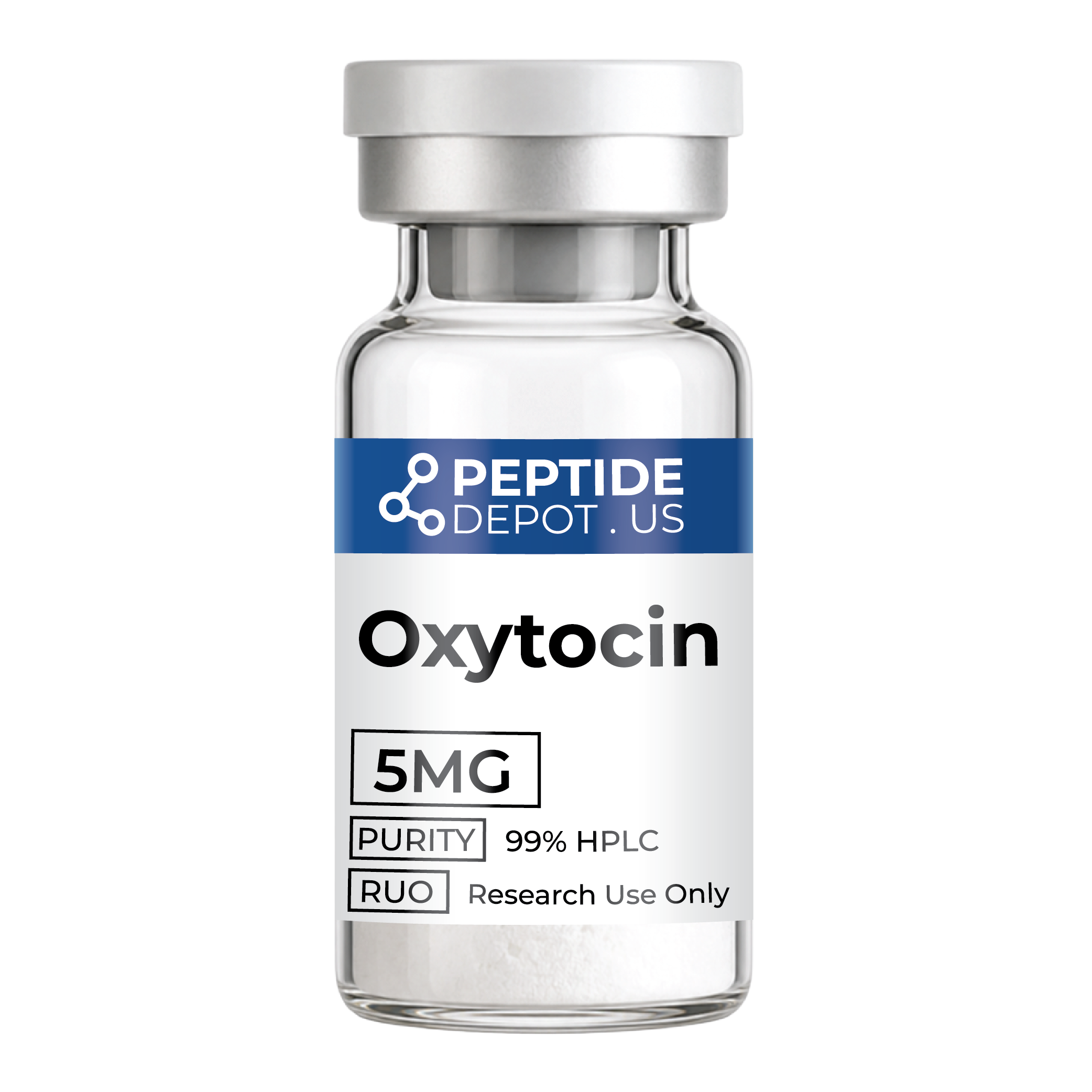
Oxytocin
Quantity
Oxytocin
Order now, ships today
One-time
Adjust quantity in your cart. Pay via Venmo or Zelle after ordering.
Oxytocin
5mg
Oxytocin Overview
Oxytocin is a naturally occurring neuropeptide hormone produced primarily in the hypothalamus and released by the posterior pituitary gland. It plays a significant role in social behavior, neuroendocrine signaling, reproductive physiology, maternal behavior, and interpersonal bonding processes. Researchers have extensively studied oxytocin due to its involvement in social cognition, emotional processing, stress regulation, reproductive biology, and neurobehavioral signaling. Because oxytocin receptors are distributed throughout both the central nervous system and peripheral tissues, the peptide has become a major focus of investigation across multiple scientific disciplines. Oxytocin remains one of the most extensively researched neuropeptides in neuroscience, endocrinology, behavioral science, and reproductive biology.
History
Oxytocin was first identified in the early twentieth century during investigations into hormones involved in reproductive physiology. Scientists later isolated and characterized the peptide, eventually discovering its important role in childbirth, lactation, and neuroendocrine regulation. As research advanced throughout the twentieth century, investigators uncovered oxytocin's broader functions within the central nervous system. Studies revealed its involvement in social bonding, emotional regulation, stress adaptation, and behavioral signaling, dramatically expanding scientific interest in the peptide. Today, oxytocin continues to be a major focus of research within neuroscience, psychology, endocrinology, and behavioral biology due to its diverse physiological and neurobehavioral effects.
Research Findings
Oxytocin is a naturally occurring neuropeptide that functions as both a hormone and neurotransmitter. It plays an important role in coordinating communication between the nervous system and endocrine system and has become one of the most extensively studied signaling molecules in behavioral and neuroendocrine research. Researchers have investigated oxytocin due to its involvement in social cognition and interpersonal behavior. Experimental studies suggest that oxytocin signaling may influence social recognition, emotional processing, trust-related behaviors, and various aspects of social interaction. These findings have generated significant interest within behavioral neuroscience and psychology research. In addition to its neurological effects, oxytocin has been extensively studied within reproductive biology. Researchers have examined its role in reproductive physiology, maternal behavior, lactation-related processes, and neuroendocrine signaling pathways associated with reproduction. Scientific investigations have also explored oxytocin's relationship with stress regulation and autonomic nervous system function. Experimental models have evaluated how oxytocin signaling may influence physiological responses to environmental and psychological stressors. Additional research continues to examine oxytocin's effects on emotional processing, social communication, neuroplasticity, and hormonal regulation. Due to its broad range of biological activities, oxytocin remains a significant area of interest across multiple fields of biomedical science. Further studies are necessary to fully characterize the complex biological mechanisms through which oxytocin influences behavior, physiology, and neuroendocrine function.
Key areas of research:
- Neuroscience Research
- Behavioral Science Research
- Social Cognition Research
- Neuroendocrinology Research
- Reproductive Biology Research
- Stress Response Research
- Hormonal Signaling Research
- Maternal Behavior Research
- Emotional Processing Research
- Social Bonding Research
References
- Oxytocin Pathways and the Evolution of Human Behavior
- Oxytocin and Social Bonding Research
- The Oxytocin Receptor System and Behavioral Regulation
References are provided for research context only and do not constitute medical claims. Oxytocin is sold for laboratory research use only.
Our Process
Lab-made.
Batch-tested.

Step 1
Precision Lyophilization
Manufactured in a controlled U.S. facility under strict compounding standards.
Step 2
Verified Purity
Every batch third-party tested with HPLC and mass spectrometry.

Step 3
Same-Day Fulfillment
Orders dispatched same-day from our U.S. facility.
Real humans, real fast
Text us. Our team
replies in minutes.
Questions about a product, an order, or a COA? Text the team and you'll get a real person in under five minutes during business hours.
Text support coming soonSample of how our team responds. Average reply time during business hours: under 5 minutes.